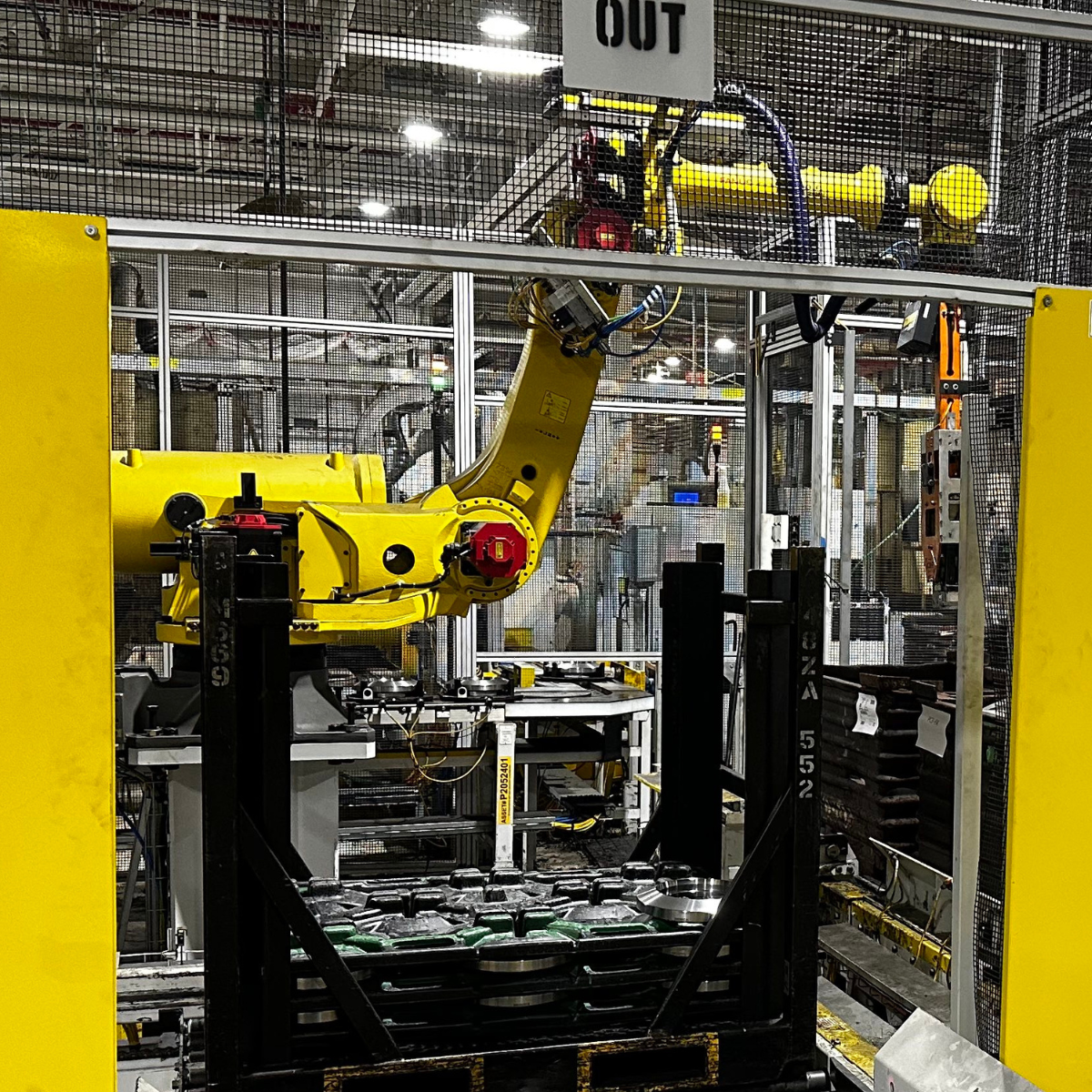
When a business explores automation, one question always rises to the top: what is the true return on our investment? At Automated Systems, Inc., we approach this question with clear economic facts. The decision to move forward with robotic integration is a direct financial strategy built to address specific pressures. We see it solve rising labor costs, consistent output quality demands and the intense pressure of global competition. The return on investment comes from tackling these areas head-on to turn what was once an ongoing cost into a measurable gain.
Transforming Labor Costs from Variable to Fixed
Let’s start with labor, often the largest and most variable operating expense. Wages increase, benefits add up and the search for skilled workers can slow growth. Robotic integration directly addresses this. Once a robot is programmed for a task – whether welding, assembly or material handling – it performs that work shift after shift. It doesn’t require overtime pay, doesn’t call in sick and doesn’t experience fatigue.
This shifts your labor equation. You can reassign your valuable human team to roles that require judgment, oversight and problem-solving, while the robot handles repetitive, physically demanding work. The financial return is clear: you gain higher total output without a proportional rise in payroll and you protect your operation from the disruptions of turnover and absenteeism.
Eliminating Costly Variation and Waste
Next, consider consistency. Human variation is a natural part of production in many processes, especially welding, painting or detailed assembly. A slight tremor, a moment of distraction or simple fatigue can lead to a part that needs rework or must be discarded. Each error represents wasted material, extra labor for correction and potential delays.
Robotic integration removes this variation. A robot follows its programmed path with exact repeatability. Every weld bead is placed identically; every coat of paint is applied with the same thickness; every component is assembled with the same force. This level of repeatability drastically cuts down on scrap and rework. You use materials more effectively, spend less time correcting mistakes and ship more good parts the first time. This is a direct contributor to positive ROI, saving money on every cycle.
Gaining a Competitive Edge Through Speed
Finally, global competition requires that manufacturers not only make good products but do so profitably and quickly. A competitor overseas may have lower wage costs, but they cannot beat the speed and agility of a well-integrated robotic cell working right on your factory floor. Robotic integration shortens production cycles. Robots work at a steady, sustained pace, often faster than a human can maintain safely over eight hours.
They can also operate through breaks and shift changes, effectively increasing your production capacity without adding physical space. This lets you accept more orders, fulfill them faster and respond to client requests with shorter lead times. In a competitive market, this speed and increased capacity are powerful advantages that defend and grow your market share.
Our Approach to Delivering Tangible ROI
At Automated Systems, Inc., we build our projects to deliver these exact returns. Our focus is on a complete solution that works for your specific floor and your financial goals. We examine your process from end to end, design a system that fits within your operation and provide the support needed to make it successful. We help you capture the full financial benefit: lower per-part costs through reduced labor and waste and higher revenue potential through greater output and speed.
The Path from Investment to Return
Calculating the ROI of robotic integration is about concrete numbers. Factors like reduced scrap rates, labor hours redeployed and increased units shipped per day. It’s a tangible investment that pays back month after month. If you are ready to move from considering automation to calculating your own return, let’s begin that conversation. Contact us today to see how we turn integration into results.